
Many UK business owners assume enterprise hosting is reserved for multinational corporations with massive budgets. That's outdated. Today's enterprise hosting solutions are tailored for small to medium-sized businesses needing reliable, scalable infrastructure without hiring dedicated IT teams. This guide explains what enterprise hosting actually delivers, how it compares to other options, and why UK-based solutions matter for compliance, performance, and growth.
Table of Contents
- Introduction To Enterprise Hosting
- Technical Fundamentals Of Enterprise Hosting
- Security And Compliance In Enterprise Hosting
- Management, Support And User Experience
- Comparing Enterprise Hosting To Other Hosting Solutions
- Choosing The Right Enterprise Hosting For Your Business
- Summary And Next Steps
- Explore Enterprise Hosting Solutions With Us
Key takeaways
| Point | Details |
|---|---|
| Dedicated resources | Enterprise hosting provides isolated environments with guaranteed uptime of 99.99%, unlike shared hosting's variable performance. |
| Advanced security | Features include SSL certificates, firewalls, anti-malware scanning, daily offsite backups, and GDPR compliance measures. |
| Full management | 24/7 support, proactive monitoring, automated updates, and user-friendly control panels reduce internal IT workload. |
| UK infrastructure | Hosting in UK data centres ensures low latency for British audiences and simplified data protection compliance. |
| Scalable solutions | Enterprise hosting grows with your business, supporting increased traffic and resources without migration headaches. |
Introduction to enterprise hosting
Enterprise hosting is a specialised service delivering dedicated, high-performance infrastructure with comprehensive management tailored for businesses prioritising reliability and security. Unlike shared hosting, where hundreds of sites compete for the same server resources, enterprise hosting allocates specific hardware exclusively to your applications. This isolation guarantees consistent performance regardless of what neighbouring accounts are doing.
The distinction matters most when comparing hosting types:
- Shared hosting packs multiple sites onto one server, sharing CPU, RAM, and storage. Affordable but prone to slowdowns.
- VPS hosting partitions a server into virtual slices, offering more control but requiring technical knowledge to manage.
- Cloud hosting distributes resources across multiple servers for flexibility, though pricing can fluctuate unpredictably.
- Enterprise hosting combines dedicated hardware, redundant systems, and full management, removing technical complexity whilst ensuring business-grade stability.
Key components include dedicated servers with modern processors, redundant network connections preventing downtime, automated backups protecting against data loss, and expert support handling maintenance tasks. SMBs benefit from enterprise hosting because it scales with growth without forcing migrations or compromising uptime.
For businesses running customer-facing platforms, e-commerce sites, or mission-critical applications, the investment in enterprise hosting pays dividends through reduced downtime, faster load times, and peace of mind. You're not just renting server space; you're securing infrastructure designed to keep your operations running smoothly whilst experts handle the technical heavy lifting.
Technical fundamentals of enterprise hosting
The performance advantage of enterprise hosting stems from purpose-built infrastructure. Servers use high-performance CPUs like AMD Ryzen™ processors paired with ultra-fast NVMe solid-state drives, delivering read/write speeds that obliterate traditional hard drives. This translates to snappier page loads, faster database queries, and smoother user experiences.
Network architecture prioritises redundancy. Multiple internet connections ensure that if one provider experiences issues, traffic automatically reroutes through backup lines. Power systems follow the same logic: dual power supplies, uninterruptible power units, and backup generators protect against electrical failures. These layers eliminate single points of failure that plague cheaper hosting options.
Environment isolation is another cornerstone. Your hosting environment runs independently from other clients, preventing the "noisy neighbour" problem where one site's traffic spike throttles everyone else's performance. Resource allocation is guaranteed, not shared. If your plan includes 16GB RAM, that memory is yours exclusively.
Uptime guarantees typically reach 99.99%, meaning your site stays online for all but approximately 52 minutes per year. Contrast this with shared hosting averaging 99.5% uptime, which allows over 43 hours of annual downtime.
| Feature | Shared Hosting | VPS Hosting | Enterprise Hosting |
|---|---|---|---|
| CPU allocation | Shared pool | Virtual cores | Dedicated cores |
| Storage type | SATA/SSD | SSD | NVMe SSD |
| Network redundancy | Single connection | Limited redundancy | Full redundancy |
| Uptime SLA | 99.5% | 99.9% | 99.99% |
| Environment isolation | None | Virtual | Physical |
Pro tip: When evaluating technical specs, ask providers about their network uplink speeds and whether they use content delivery network integration. A 10Gbps uplink with CDN support dramatically improves content delivery to global audiences whilst maintaining UK-based primary hosting.
These infrastructure elements combine to create hosting environments where performance remains predictable under load, security boundaries stay intact, and technical failures trigger automatic failover systems rather than site outages.
Security and compliance in enterprise hosting
Enterprise hosting incorporates multi-layered security protocols addressing threats from malware to data breaches. SSL/TLS certificates encrypt data transmission between browsers and servers, protecting customer information during checkout processes or form submissions. Modern hosting platforms install and renew these certificates automatically.
Firewall protections filter incoming traffic, blocking suspicious requests before they reach your applications. Anti-malware scanning runs continuously, detecting and quarantining infected files before they compromise your site. These systems update automatically as new threats emerge, requiring no manual intervention.
Backup strategies protect against data loss from hardware failures, human errors, or ransomware attacks. Daily offsite backups store copies in geographically separate locations, ensuring that even catastrophic data centre events don't erase your business data. Retention policies typically maintain multiple restore points spanning weeks or months.
Disaster recovery plans document procedures for restoring services after major incidents. Enterprise hosting providers test these plans regularly, verifying that backups are viable and recovery time objectives are achievable. You're not left guessing whether your data can be recovered; the process is documented and proven.
Compliance with UK data protection laws and GDPR is non-negotiable for businesses handling customer information. Enterprise hosting in UK data centres simplifies compliance by keeping data within British jurisdiction, avoiding complex cross-border transfer requirements. Providers typically offer data processing agreements outlining security responsibilities and breach notification procedures.
Key security features include:
- Intrusion detection systems monitoring unusual access patterns
- DDoS mitigation absorbing volumetric attacks before they overwhelm servers
- Access controls limiting who can modify hosting configurations
- Security patch management applying updates promptly without service interruptions
- Audit logging tracking changes for compliance verification
Pro tip: Request a copy of your provider's SOC 2 or ISO 27001 certification. These third-party audits verify that security controls meet industry standards, offering assurance beyond marketing claims.
For SMBs without dedicated security staff, these built-in protections level the playing field with larger competitors whilst satisfying customer expectations around data safety.
Management, support and user experience
Comprehensive management services distinguish enterprise hosting from self-managed alternatives. Dedicated 24/7 support teams monitor infrastructure proactively, identifying potential issues before they impact availability. When problems arise, you're not troubleshooting alone; experts with deep platform knowledge diagnose and resolve issues whilst you focus on business operations.

Regular software updates maintain security and compatibility without requiring technical expertise. Server operating systems, control panel software, and security tools receive patches automatically. Automated troubleshooting handles common issues like service restarts or resource reallocation, often resolving problems before you notice them.
User-friendly control panels like DirectAdmin provide intuitive interfaces for managing email accounts, databases, file uploads, and domain configurations. You don't need command-line proficiency to perform routine administrative tasks. Point-and-click interfaces make complex operations accessible.
Application support simplifies deploying popular platforms. WordPress installations happen with single clicks rather than manual database creation and file configuration. Version management, plugin updates, and performance optimisation integrate into hosting dashboards. For businesses running multiple WordPress sites, workflow optimisation tools streamline content management across properties.
These management features reduce internal IT workload substantially:
- Server maintenance handled by provider staff
- Security monitoring conducted around the clock
- Performance optimisation applied based on usage patterns
- Technical support available via phone, email, and chat
- Documentation and tutorials accessible for self-service needs
The productivity gains compound over time. Staff previously troubleshooting hosting issues redirect effort towards revenue-generating activities. Downtime incidents decrease, protecting customer trust and sales. Technical barriers that might prevent launching new digital initiatives disappear when expert support stands ready to assist.
For SMBs evaluating total cost of ownership, factor in these labour savings alongside hosting fees. The hours reclaimed from not managing servers often justify premium pricing, especially when considering opportunity costs of technical distractions.
Comparing enterprise hosting to other hosting solutions
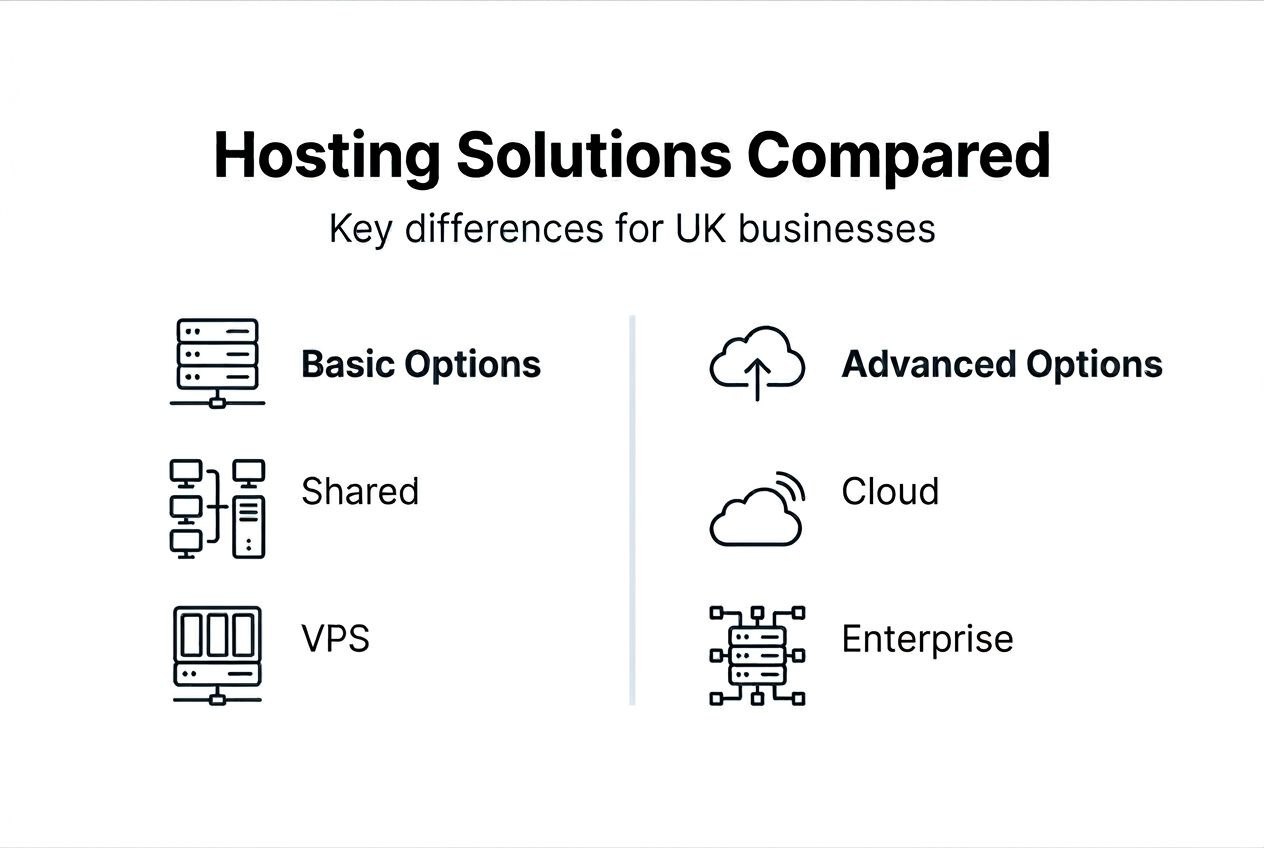
Understanding where enterprise hosting fits within the broader landscape helps match solutions to business needs. Each hosting type serves different scenarios, and choosing poorly wastes money or compromises performance.
Shared hosting costs £3-10 monthly but crams dozens or hundreds of sites onto single servers. Resources fluctuate based on neighbours' activity. Uptime typically reaches 99.5%, allowing over 3.5 hours of monthly downtime. Suitable for personal blogs or brochure sites with minimal traffic, but risky for business-critical applications.
VPS hosting partitions servers into isolated virtual machines, offering moderate scalability at £15-50 monthly. You control software installations and configurations but shoulder management responsibilities. Performance improves over shared hosting, though you're still sharing underlying hardware. Uptime reaches 99.9% with proper management. Best for businesses with technical staff comfortable administering servers.
Cloud hosting distributes applications across server clusters, enabling rapid scaling during traffic spikes. Pricing varies based on actual resource consumption, creating budget uncertainty. Uptime can exceed 99.95% with multi-region redundancy, but complexity increases with geographic distribution. Ideal for applications with unpredictable demand patterns.
Enterprise hosting dedicates entire servers or server clusters to your applications, combining dedicated resources with full management. Uptime guarantees reach 99.99% through redundant infrastructure and proactive monitoring. Monthly costs range from £100-500+ depending on specifications, but include support, security, and maintenance that would otherwise require internal IT investment.
| Feature | Shared | VPS | Cloud | Enterprise |
|---|---|---|---|---|
| Monthly cost | £3-10 | £15-50 | Variable | £100-500+ |
| Resource dedication | Shared | Virtual | Distributed | Dedicated |
| Management level | Basic | Self-managed | Partial | Fully managed |
| Uptime SLA | 99.5% | 99.9% | 99.95% | 99.99% |
| Scalability | Limited | Moderate | High | High |
| Technical requirement | None | Moderate | High | None |
| Best for | Personal sites | Tech-savvy SMBs | Variable workloads | Business-critical apps |
Pro tip: Calculate total cost of ownership rather than comparing monthly fees alone. Factor in staff time for management, downtime costs, security breach risks, and opportunity costs of technical limitations. Enterprise hosting often proves more economical when accounting for these hidden expenses.
The right choice depends on traffic volume, uptime requirements, technical capabilities, and growth trajectory. Businesses generating significant revenue online or handling sensitive customer data typically find enterprise hosting's reliability and security worth the premium over alternatives that might save money initially but cost more through incidents and limitations.
Choosing the right enterprise hosting for your business
Selecting an enterprise hosting provider requires evaluating multiple factors beyond pricing. These criteria help identify partners aligned with your business requirements:
-
Verify uptime commitments. Request service level agreements specifying uptime percentages and compensation for breaches. Look for 99.99% guarantees backed by credits or refunds when providers fall short. Ask about historical uptime data and monitoring transparency.
-
Assess data centre locations. UK-based facilities offer latency advantages for British audiences and simplified GDPR compliance. Data sovereignty matters when customer information stays within UK jurisdiction, avoiding cross-border transfer complexities.
-
Evaluate security features. Confirm inclusion of SSL certificates, firewall protections, malware scanning, and daily backups. Review disaster recovery procedures and backup retention policies. Request evidence of security certifications and compliance audits.
-
Test support responsiveness. Contact support teams before purchasing to gauge response times and expertise. Ask technical questions to assess whether staff can troubleshoot complex issues. Verify support channel availability matching your operational hours.
-
Review scalability options. Ensure plans accommodate traffic growth without forced migrations. Check whether resource upgrades happen seamlessly or require downtime. Understand pricing structures as your requirements expand.
-
Examine contract flexibility. Avoid long-term commitments until you've validated platform reliability. Monthly billing provides exit options if service quality disappoints. Read cancellation policies carefully to understand refund terms.
-
Request trials or demonstrations. Hands-on testing reveals interface usability and performance characteristics. Migrate a test site to evaluate migration processes and workflow efficiency. Monitor load times from various UK locations.
-
Compare technical specifications. Review CPU generations, RAM amounts, storage types, and network speeds. Older hardware undermines enterprise hosting benefits. Confirm whether specifications are guaranteed minimums or shared maximums.
-
Investigate management scope. Clarify which tasks providers handle versus responsibilities remaining with you. Understand whether software updates, security patches, and performance optimisation happen automatically or require requests.
-
Calculate total investment. Factor in setup fees, monthly costs, overage charges, and add-on services. Compare all-inclusive pricing against à la carte models. Project expenses as your site grows to avoid budget surprises.
UK data centres deserve particular attention for businesses serving British customers. Hosting proximity reduces latency, improving page load speeds that influence search rankings and user satisfaction. Regulatory compliance simplifies when data processing occurs within the jurisdiction governing your business operations.
Practical steps include scheduling consultations with shortlisted providers, requesting custom quotes based on your traffic patterns, and testing support quality through pre-sales questions. Invest time in due diligence now to avoid costly migrations later when dissatisfaction or limitations force changes.
Summary and next steps
Enterprise hosting delivers dedicated resources, advanced security, comprehensive management, and business-grade reliability tailored for UK businesses prioritising performance and compliance. The combination of 99.99% uptime guarantees, proactive support, automated security measures, and UK-based infrastructure creates hosting environments where digital operations run smoothly whilst internal teams focus on core business activities.
Key advantages include isolated environments eliminating shared hosting's performance variability, full management reducing IT workload, robust security satisfying data protection obligations, and scalability supporting business growth without forced migrations. For SMBs competing online, these benefits often justify premium pricing through reduced downtime costs, improved customer experiences, and reclaimed staff productivity.
Matching hosting to business needs requires honest assessment of traffic volumes, uptime importance, technical capabilities, and budget constraints. Enterprise hosting suits organisations where digital presence directly impacts revenue, customer trust depends on security and reliability, or technical limitations constrain growth.
Next actions include evaluating current hosting performance against business requirements, researching providers with UK infrastructure and proven track records, scheduling consultations to discuss specific needs, and testing platforms through trials before committing. The investment in proper hosting infrastructure pays dividends through smoother operations, happier customers, and competitive advantages in an increasingly digital marketplace.
Explore enterprise hosting solutions with us
Now that you understand enterprise hosting's advantages for UK businesses, consider how the right infrastructure partner accelerates your digital success. Our enterprise hosting solutions combine Coventry-based data centres, NVMe storage, AMD Ryzen™ processors, and comprehensive management designed specifically for growing British businesses.
We handle server maintenance, security monitoring, software updates, and technical troubleshooting whilst you focus on serving customers. Our 24/7 support team and user-friendly DirectAdmin interface make advanced hosting accessible without requiring technical expertise. Whether you're running WordPress sites, e-commerce platforms, or custom applications, our scalable plans grow with your business needs. Explore our hosting options or contact our team to discuss how enterprise infrastructure supports your specific goals.
FAQ
What is the difference between enterprise hosting and shared hosting?
Enterprise hosting provides dedicated server resources, advanced security measures, and comprehensive management with 99.99% uptime guarantees. Shared hosting splits resources among multiple users, resulting in variable performance, lower reliability around 99.5% uptime, and minimal security features suitable only for low-traffic sites.
Is enterprise hosting suitable for small UK businesses with limited IT staff?
Yes, enterprise hosting particularly benefits small businesses lacking technical teams. Providers include 24/7 expert support, automated maintenance, security monitoring, and user-friendly control panels that eliminate the need for in-house server administration. This allows small teams to access enterprise-grade infrastructure without hiring specialists.
How does UK data centre location affect enterprise hosting performance and compliance?
UK data centres reduce latency for British visitors, improving page load speeds that influence search rankings and user satisfaction. They also ensure compliance with UK data protection laws and GDPR by keeping customer information within British jurisdiction, simplifying legal requirements compared to hosting data abroad. Learn more about UK infrastructure advantages for regulatory and performance benefits.
What uptime guarantee should I expect from enterprise hosting?
Enterprise hosting typically guarantees 99.99% uptime, allowing approximately 52 minutes of annual downtime. This reliability stems from redundant hardware, multiple network connections, backup power systems, and proactive monitoring. Service level agreements should specify compensation when providers breach uptime commitments.
How much does enterprise hosting cost compared to other options?
Enterprise hosting ranges from £100 to £500+ monthly depending on specifications, significantly more than shared hosting at £3-10 or VPS at £15-50. However, the total cost of ownership often favours enterprise hosting when factoring in management labour savings, reduced downtime losses, security breach prevention, and productivity gains from reliable infrastructure.