
Many UK businesses assume international hosting delivers superior speed and lower costs. Reality paints a different picture. Modern UK hosting infrastructure powered by AMD Ryzen processors and NVMe storage provides dramatically lower latency for British audiences while ensuring GDPR compliance. This guide explains how UK hosting infrastructure works, what technical components matter, and how to select the right solution for your business needs.
Table of Contents
- Introduction To UK Hosting Infrastructure
- Key Components Of UK Hosting Infrastructure
- Benefits Of Local UK Data Centre Hosting
- Security Features And Protocols In UK Hosting
- Common Misconceptions About UK Hosting Infrastructure
- Comparing Hosting Types For UK SMB Needs
- How To Choose The Right UK Hosting Provider
- Conclusion And Next Steps
- Explore Reliable UK Hosting Solutions With Rivet Cloud Hosting
- Frequently Asked Questions
Key takeaways
| Point | Details |
|---|---|
| Local infrastructure advantage | UK-based hosting reduces latency and ensures compliance with British data protection laws |
| Modern hardware standards | AMD Ryzen CPUs and NVMe storage deliver enterprise-grade performance for growing businesses |
| Security protocols | Standard UK hosting includes DDoS protection, malware firewalls, and automated backups |
| Data centre benefits | Physical UK location provides network redundancy and faster response times for British users |
| Hosting type selection | Choose shared, VPS, or dedicated based on traffic volume, security needs, and budget |
Introduction to UK hosting infrastructure
The UK hosting market has evolved significantly to serve small and medium businesses requiring fast, compliant digital infrastructure. Physical server location directly impacts website performance, especially for audiences concentrated in Britain. Hosting within UK data centres ensures your site loads quickly for customers in London, Manchester, Edinburgh, and everywhere between.
Local infrastructure matters more than many business owners realise. When visitors access your website, data travels between their device and your server. Shorter physical distances mean faster loading times and better user experiences. UK hosting also simplifies regulatory compliance, keeping customer data within British jurisdiction where GDPR and data protection laws apply consistently.
Common challenges prevent businesses from maximising hosting benefits:
- Misunderstanding how local hosting improves performance metrics
- Getting overwhelmed by technical specifications and jargon
- Struggling to compare hosting types and infrastructure components
- Underestimating security requirements for customer data protection
Understanding these infrastructure fundamentals helps you make confident decisions aligned with business growth.
Key components of UK hosting infrastructure
Modern UK hosting relies on specific hardware components that determine speed, reliability, and capacity. These technical building blocks work together to deliver consistent performance for websites and applications.
AMD Ryzen 9 processors represent current-generation CPU technology designed for multitasking workloads. These chips handle multiple simultaneous requests efficiently, preventing slowdowns during traffic spikes. Higher core counts let servers process more operations concurrently, keeping websites responsive even under load.
Gen4 PCIe NVMe solid-state drives revolutionise storage performance. Traditional hard drives struggle with read/write speeds, creating bottlenecks that slow database queries and file access. NVMe technology eliminates these delays, delivering up to 5000% faster data retrieval compared to spinning disks. This translates directly to quicker page loads and smoother user interactions.

UK data centres maintain rigorous standards for connectivity and uptime. Multiple network providers ensure redundant internet connections, so single failures never take sites offline. Climate control systems protect hardware from overheating. Backup power generators maintain operations during electrical outages. Dedicated servers with AMD Ryzen and NVMe SSDs can provide up to 99.99% uptime when paired with proper infrastructure management.
Pro Tip: Prioritise hosting providers offering enterprise-grade AMD Ryzen processors and NVMe storage to ensure consistent performance during peak demand periods.
Benefits of local UK data centre hosting
Physical server placement within Britain delivers measurable advantages for businesses serving UK customers. These benefits extend beyond simple geography to encompass legal, technical, and operational improvements.
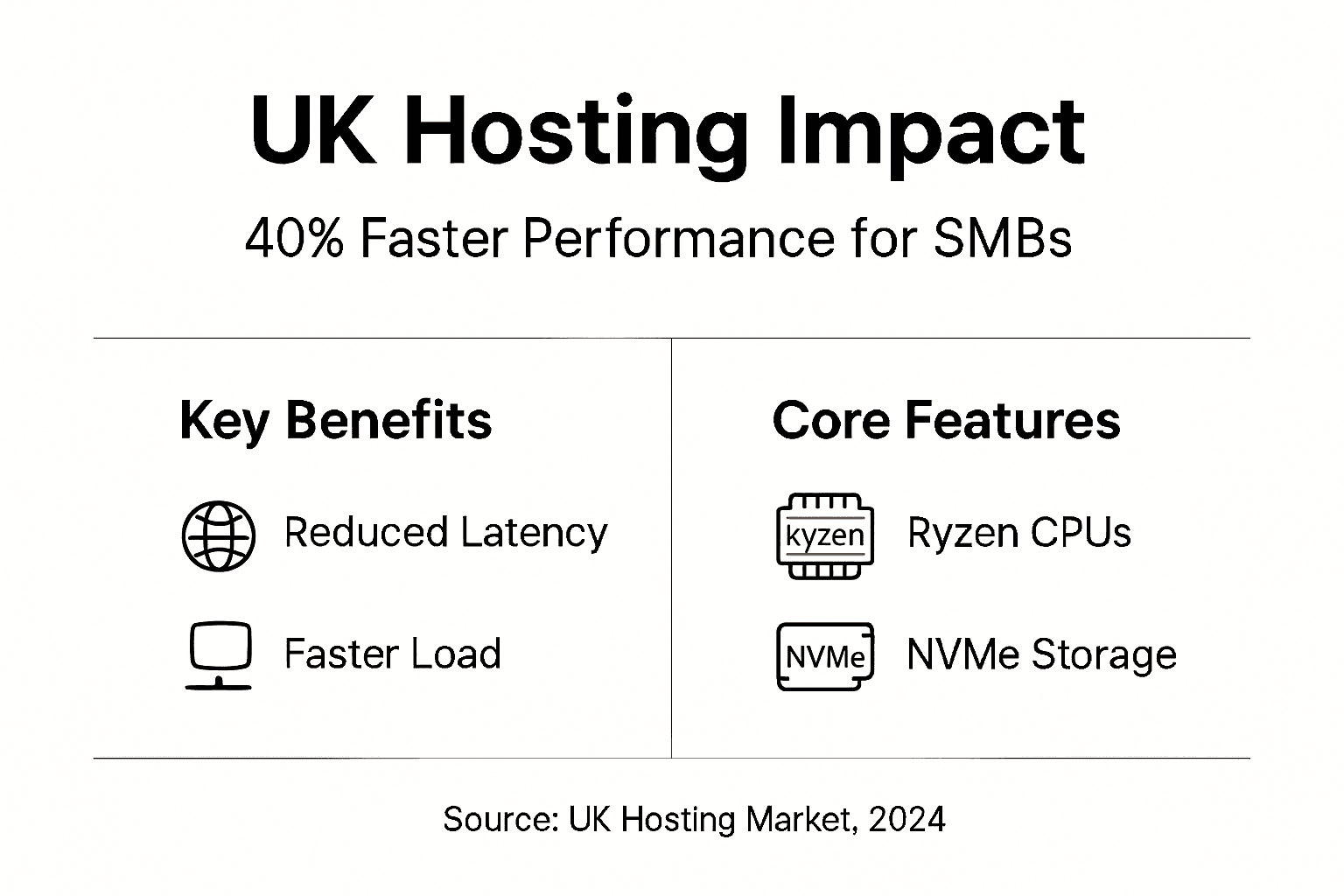
Latency reduction stands as the most immediate benefit. Data travelling between British data centres and UK users covers shorter distances with fewer network hops. This physical proximity can reduce latency by up to 40% compared to hosting on international servers. Faster response times improve search rankings, conversion rates, and user satisfaction.
Data sovereignty simplifies regulatory compliance significantly. Keeping customer information within UK jurisdiction means British privacy laws apply clearly. GDPR compliance becomes straightforward when data never crosses international borders. You avoid complex questions about data transfer agreements and foreign government access.
Network infrastructure in major UK regions provides robust connectivity:
- Multiple tier-1 network providers ensure redundant routing
- Direct peering arrangements with British ISPs reduce bottlenecks
- Geographic diversity protects against regional outages
- Low-latency connections to London Internet Exchange points
Statistic: Local UK hosting can reduce website loading times by 40% for British visitors compared to international alternatives, directly improving conversion rates and search visibility.
Security features and protocols in UK hosting
Comprehensive security measures protect business websites from threats while maintaining uptime. UK hosting providers implement multiple defence layers addressing different vulnerability types.
Standard protection features include distributed denial-of-service mitigation that filters malicious traffic before it reaches your server. Anti-malware firewalls scan incoming requests for known attack patterns. Automated backup systems create regular snapshots of website files and databases, enabling quick recovery from data loss incidents. These protections run continuously without requiring manual intervention.
Physical data centre security matches digital protections. CCTV surveillance monitors facility access points around the clock. Biometric authentication controls entry to server rooms. Security personnel conduct regular patrols. Climate monitoring systems alert staff to temperature or humidity changes that could damage equipment.
Backup and disaster recovery policies determine how quickly operations resume after incidents. Daily incremental backups capture recent changes efficiently. Weekly full backups provide comprehensive restore points. Offsite backup storage protects against facility-wide failures. Dedicated servers with AMD Ryzen and NVMe SSDs offer 99.99% uptime with enterprise-grade hardware and continuous UK support.
Pro Tip: Verify your provider's service level agreement includes guaranteed hardware replacement timeframes and 24/7 monitoring with human response teams, not just automated systems.
Common misconceptions about UK hosting infrastructure
Several persistent myths discourage businesses from choosing British hosting providers. Examining these misconceptions reveals the actual advantages local infrastructure provides.
-
UK hosting costs significantly more than international alternatives. Reality shows competitive pricing structures once you account for performance benefits and compliance simplification. Hidden costs of international hosting include potential data transfer fees, currency conversion charges, and legal consultation expenses for regulatory questions.
-
International hosting always delivers faster speeds regardless of audience location. This ignores basic physics governing data transmission. UK servers consistently outperform distant alternatives for British visitors, often achieving 40% faster loading times. Global content delivery networks can supplement local hosting but cannot replace proximity advantages entirely.
-
British hosting infrastructure uses outdated technology compared to larger international markets. Modern UK data centres deploy current-generation AMD Ryzen processors, NVMe storage arrays, and cutting-edge network equipment. Infrastructure investment keeps pace with global standards while maintaining British regulatory compliance and support availability.
Comparing hosting types for UK SMB needs
Different hosting configurations suit varying business requirements, traffic levels, and budgets. Understanding these options helps match infrastructure to specific needs.
| Feature | Shared Hosting | VPS Hosting | Dedicated Servers |
|---|---|---|---|
| CPU Resources | Shared pool | Dedicated cores | Entire processor |
| RAM Allocation | Limited, shared | Guaranteed allocation | Full server memory |
| Storage Type | Standard SSD | NVMe available | Enterprise NVMe |
| Security Level | Basic firewall | Enhanced isolation | Complete control |
| Typical Cost | £3-10/month | £15-50/month | £80-200+/month |
| Best For | New websites | Growing businesses | High traffic sites |
Shared hosting suits businesses just establishing online presence. Multiple websites occupy the same server, sharing resources like CPU cycles and memory. This keeps costs minimal but limits performance during traffic spikes. Basic security features protect against common threats.
VPS hosting provides dedicated resources within shared infrastructure. Your allocation of AMD Ryzen CPU cores and NVMe storage remains guaranteed regardless of neighbouring sites. Better isolation improves security and performance consistency. Scalability lets you upgrade resources as traffic grows without migrating to completely new servers.
Dedicated servers offer exclusive hardware access. Entire processors, memory banks, and storage arrays serve only your applications. This configuration delivers maximum performance, security, and customisation freedom. High-traffic e-commerce sites, compliance-sensitive applications, and resource-intensive platforms benefit most.
Use case considerations:
- Brochure websites and blogs: Shared hosting provides sufficient resources
- Growing online stores: VPS hosting balances performance and cost
- Enterprise applications: Dedicated servers ensure reliable performance
- Development agencies: Reseller hosting with VPS-level resources supports multiple clients
How to choose the right UK hosting provider
Selecting appropriate hosting requires evaluating multiple factors against your specific business requirements. This systematic approach ensures infrastructure aligns with operational needs.
-
Assess current and projected traffic volumes. Review analytics to understand peak concurrent visitors. Plan for growth by selecting hosting that accommodates 2-3x current traffic without performance degradation.
-
Prioritise UK data centre locations for British audiences. Physical proximity reduces latency and ensures data sovereignty. Verify the provider operates servers within Britain rather than simply maintaining UK business registration.
-
Confirm AMD Ryzen processors and NVMe storage availability. These components directly impact website speed and database performance. Avoid providers still using older generation hardware.
-
Evaluate comprehensive security implementations. Standard features should include DDoS mitigation, malware scanning, automated backups, and free SSL certificates. Physical security measures at data centres add another protection layer.
-
Consider managed services for technical support. Fully managed hosting includes server maintenance, security updates, and performance optimisation. This frees your team to focus on business operations rather than infrastructure management.
-
Match hosting type to business scale and budget. Start with VPS hosting for most growing SMBs, as it balances cost with performance. Upgrade to dedicated servers when traffic consistently exceeds VPS capacity.
-
Review uptime guarantees and support responsiveness. Service level agreements should specify 99.9% minimum uptime with compensation for failures. Test support channels before purchasing to verify response quality.
Pro Tip: Request a trial period or money-back guarantee when evaluating new hosting providers, allowing real-world performance testing with your actual website before committing long-term.
Conclusion and next steps
UK hosting infrastructure delivers measurable advantages for British businesses through reduced latency, simplified compliance, and robust security. Modern AMD Ryzen processors paired with NVMe storage provide the performance foundation growing websites require. Local data centre placement ensures faster loading times for UK audiences while keeping data within British jurisdiction.
Choosing appropriate hosting starts with understanding your traffic patterns, security requirements, and budget constraints. VPS hosting suits most growing SMBs, offering dedicated resources without dedicated server costs. Dedicated infrastructure becomes necessary as traffic scales or compliance requirements intensify.
Apply this knowledge by evaluating current hosting against the standards discussed. Compare processor specifications, storage technology, and security implementations. Prioritise providers operating physical infrastructure within Britain rather than reselling international services. Verify uptime guarantees and support availability match business needs.
Confident hosting decisions stem from understanding how infrastructure components impact real-world performance. Use these criteria to select solutions supporting current operations while accommodating future growth.
Explore reliable UK hosting solutions with Rivet Cloud Hosting
Rivet Cloud Hosting operates modern infrastructure from their Coventry data centre, delivering the local performance and compliance benefits discussed throughout this guide. Their hosting platform utilises AMD Ryzen processors and NVMe storage to ensure fast loading times for UK audiences.

Comprehensive security features include anti-malware firewalls, daily offsite backups, and free SSL certificates. The fully managed approach handles technical maintenance, letting you focus on business growth rather than server administration. DirectAdmin control panels simplify website management without requiring technical expertise. Services span shared hosting for new sites through VPS and reseller options for growing businesses.
24/7 UK-based support ensures technical assistance remains available when needed. Low-latency connections across Britain deliver consistent performance for visitors throughout England, Scotland, Wales, and Northern Ireland. Explore Rivet Cloud Hosting to find hosting solutions matching your SMB requirements with transparent pricing and straightforward migration support.
Frequently asked questions
What makes AMD Ryzen CPUs ideal for UK hosting?
High core counts in Ryzen processors enable efficient multitasking across multiple website visitors simultaneously. This prevents slowdowns during traffic spikes when many users access your site concurrently. Energy-efficient architecture reduces heat generation, helping maintain stable operating temperatures that extend hardware lifespan and reduce failure rates.
How does hosting in a UK data centre improve website speed?
Physical proximity between servers and UK visitors reduces data transmission time measurably. Shorter distances mean fewer network routing hops and lower latency for each request. British data centres also maintain direct peering relationships with major UK internet service providers, creating faster pathways between hosting infrastructure and end users.
What security measures should UK SMBs expect from their hosting?
Standard protections include distributed denial-of-service mitigation that filters attack traffic, anti-malware firewalls scanning for threats, and automated daily backups enabling quick recovery. Professional hosting adds 24/7 monitoring with rapid hardware replacement guarantees. Physical security features like biometric access controls and CCTV surveillance protect data centre facilities from unauthorised entry.
Which hosting type suits a growing UK small business?
VPS hosting typically provides the best balance for businesses experiencing steady traffic growth. Dedicated CPU cores and guaranteed RAM allocations ensure consistent performance without dedicated server costs. This configuration supports scaling as traffic increases while maintaining reasonable monthly expenses. Dedicated servers become appropriate when traffic consistently exceeds VPS capacity or specialised security requirements demand complete hardware isolation.